Laser printer buying guide
Toner Yield Guide: Standard vs High Yield Cartridges
Toner yield is one of the most useful numbers on a laser-printer supply page, but it is also one of the easiest to misunderstand. Yield is an estimate, not a promise that every office will print exactly that number of pages.
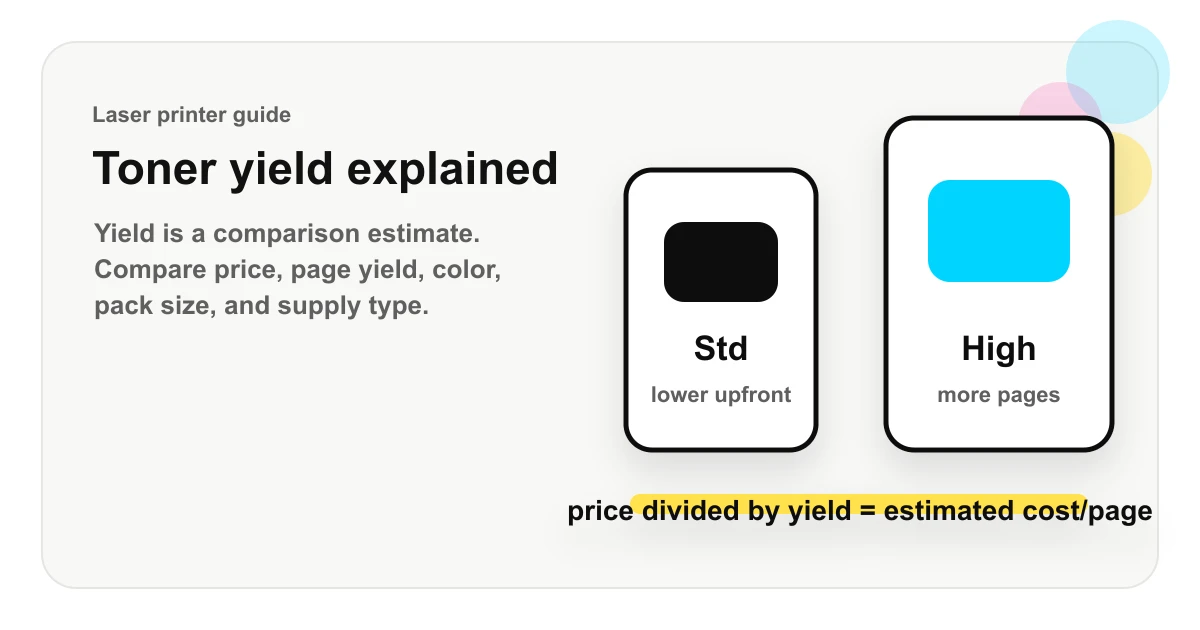
Cartridge price divided by page yield gives an estimated supply cost per page.
Dense graphics, dark pages, labels, and images can use toner faster than light text.
Make sure the listing is toner, not a drum unit, imaging unit, or waste toner box.
What toner yield means
Toner yield is the estimated number of pages a cartridge can print under a standardized test pattern. For many monochrome toner cartridges, yield is often discussed around a low page-coverage assumption. Real pages may use more or less toner depending on text density, graphics, images, page size, printer settings, and duplexing habits.
A cartridge listed at 3,000 pages does not guarantee that every user will print 3,000 pages. It gives you a comparison point against another cartridge for the same printer family.
Standard yield vs high yield toner
Standard-yield toner usually has a lower upfront price and a lower page estimate. High-yield toner usually costs more at checkout but prints more pages before replacement. Extra-high-yield versions may exist for some printer families.
The right choice depends on print volume. If a printer is used constantly for invoices, shipping labels, forms, packets, or internal documents, high-yield toner often makes sense. If a printer sits unused for long periods or prints only occasional paperwork, standard yield may be enough.
| Option | Typical advantage | Tradeoff | Good fit |
|---|---|---|---|
| Standard yield | Lower checkout price. | Usually higher cost per page and more frequent replacements. | Low-volume printers, backup printers, or occasional home-office use. |
| High yield | More printed pages before replacement. | Higher upfront price. | Frequent document printing, teams, shipping labels, forms, and office packets. |
| Extra high yield | Often the lowest estimated supply cost per page. | Highest upfront price and not available for every printer. | High-volume offices that want fewer interruptions. |
How to compare cost per page
Cost per page is usually estimated by dividing cartridge price by page yield. For example, a 3,000-page cartridge at $30 has an estimated cartridge cost of one cent per page before tax, shipping, coupons, returns, or other costs.
Use cost per page as a comparison tool, not a perfect forecast. Coupons, multipacks, shipping thresholds, seller pricing, and real print coverage can change the actual economics.
Why page coverage changes yield
A page with a few lines of text uses much less toner than a page with dense graphics, large black areas, charts, photos, or heavy logos. If your office prints labels, forms, or text documents, you may get closer to the listed yield. If you print full-page graphics, menus, flyers, or dark documents, expect lower real-world yield.
Printer settings also matter. Draft mode, toner save mode, duplexing, and grayscale settings can affect toner use. So can repeated calibration, cleaning, or test pages.
Toner cartridge vs drum unit
Toner and drum are not always the same supply. Toner contains the powder used to print. A drum unit helps transfer toner onto the paper. Some printers combine both parts into one cartridge, while others use separate toner cartridges and drum units.
This is a common buying mistake. If your printer says to replace the drum, buying toner may not fix the message. If your printer is out of toner, buying a drum unit may not restore printing. Always check the supply type on the product page.
Color laser toner yield
Color laser printers usually use black, cyan, magenta, and yellow toner. Each color can have a different yield, and real-world use depends on the color mix in your documents. A business printing mostly black text may replace black toner more often than color. A classroom or marketing team printing charts and graphics may consume colors faster.
When buying color toner sets, compare each cartridge number, color, yield, and pack size. A four-pack can be convenient, but only if the printer uses all four cartridges and the listed replacements match your machine.
When high-yield toner makes sense
- The printer is used every week or every day.
- You print invoices, shipping labels, school packets, reports, or office forms.
- You want fewer replacements and less downtime.
- The high-yield version has a lower estimated cost per page.
- The seller clearly lists the replacement cartridge number and compatible printer models.
Toner buying checklist
Confirm the printer model, cartridge number, supply type, color, yield, pack size, and seller policy. Check whether the product is toner, drum, imaging unit, waste toner box, or maintenance supply. Then compare price against yield so you are not choosing only by the lowest checkout price.
FAQ
What does toner page yield mean?
Toner page yield is an estimate of how many pages a cartridge can print under a standard test pattern. Real-world yield varies by page coverage, settings, paper, and print behavior.
Is high-yield toner always better?
High-yield toner often lowers cost per page for frequent printing, but standard yield may be better for low-volume users or printers used only occasionally.
Is a drum unit the same as toner?
No. Toner contains the powder used to print. A drum unit transfers toner to the page. Some printers combine toner and drum, while others sell them separately.